To see Samuel Beckett’s face on the computer screen, but hear the voice of Michael Gira of Swans — who has chosen a famous 1973 photograph of the avant-garde playwright as his Skype avatar — makes perfect sense. This pose of Beckett’s (lines etched on to a craggy head floating in a void) is immortal and intense, in much the same way that the cracked yet acutely sure voice of the 58-year-old Swans frontman is. And where famously Beckett’s play Waiting For Godot was boiled down to the description “nothing happens, twice” by Irish critic Vivian Mercier, a Swans live show during the band’s mid-eighties incarnation might be paraphrased, “nothing happens again and again and it’s FUCKING LOUD”.
Google the 1986 clip “Swans ‘A Screw (Holy Money) (live)’” and over slamming drums and Norman Westberg’s tortured guitar, Gira’s razor-wire gurgle seems a pure prototype of the vocal of Kurt Cobain. The singer was a big fan of Swans (1984’s ‘Young God’ EP, in particular), and it was Nirvana, Mudhoney and Swans’ old road-mates Sonic Youth who would carry the torch for loud, uncompromising American guitar music into the 1990s. While others around them hit pay dirt, Swans eventually broke up in 1997 after the pressure of never quite making enough money finally took its toll. It would be 13 years before they’d release another record.
One of the most striking things about Swans’ new (double) album, The Seer, as opposed to 2010’s My Father Will Guide Me Up A Rope To The Sky is the lurching rhythm that seems to hold it all together, as heard on ‘The Seer Returns’, ‘The Apostate’ and elsewhere.
“A salient preoccupation is the groove,” says Gira about The Seer. “We’re not playing dance music or anything, but I am a big fan of Can and Miles Davis’s album On The Corner. Things like that can just endlessly repeat. I was just trying to find the right place inside it [the groove] and then build things from there.”
It suggests a band that has found its rhythm following the initial exultant shock of reanimation that was Swans’ triumphant return. Whereas My Father… was based on defined songs written on acoustic guitar by Gira and recorded by the band in a disused factory building in Brooklyn, The Seer is a more varied exploration of the potential of Swans mark II, complete with gargantuan, 32-minute title track, and the closing two songs, ‘A Piece Of The Sky’ and ‘The Apostate’, that together clock in at 42 minutes.
This time, the band recorded for 10 days in Berlin during their last tour and for a few weeks in New York after that. Gira spent months sleeping on the couch at Marcata studio in upstate New York putting the disparate elements together from the prolonged sessions that were based on songs that had evolved during the tour. As he is a self-taught musician and producer, his process of putting tracks together is one of trial and error.
“Record, record, record and then I have to deal with the consequences later,” he says. “To me, it’s torture. Frequencies collide and can make things very muddy, whereas a skilled arranger would know what to put on tape. If you listen to Ziggy Stardust, for instance, it’s impeccable. That’s a really intelligent arrangement, whereas what I do is throw shit at the wall and then try and make a painting out of it.”
A case in point of this approach is ‘A Piece Of The Sky’, which includes a snooze-and-you’ll-miss-it return of Jarboe, member of Swans from 1986 until the band split, and Gira’s partner during that time. Around two minutes in, Jarboe rises out of the song like a pillar of light, samples of her distinctive vocal turned into a collage that appears within the long sound piece at the beginning of the track.
“Knowing her abilities, I wanted these drone vocals but with character in them,” explains Gira. “She sent me a bunch of takes with a note or two notes, and I put them into this sound collage — and it worked.”
In addition to the groove, The Seer is peppered with a feeling of calm — a sense of reflection, acceptance and positivity among the tumult. It’s in the optimistic close of ‘Piece Of The Sky’, for example, and the beautiful ‘Song For A Warrior’, which is sung by Karen O of Yeah Yeah Yeahs. The latter contains a contender for knockout love lyric of the year: “Some people say / God is long dead / I heard something inside you / With my head to your chest.”
“It’s pretty sentimental, but hopefully not saccharine,” Gira says. “It’s dedicated to my six-year-old daughter. I tried to sing it and I sounded like Howlin’ Wolf trying to sound like Nick Drake — it just seemed that my voice was inappropriate.”
Gira had met a pre-fame Karen O at gigs in New York during the nineties. He noticed her dancing wildly to Flux Information Sciences, a group on his label, Young God Records, that his wife Siobhan Duffy (who now lives with Gira in the Catskills with their two children) played drums for.
“She would always be by herself — just one of those punk chicks you see who is oblivious to their surroundings; who was completely immersed in the music and didn’t give a shit who she bumped into.”
It was a similar desire for a kind of total freedom-in-rock that made Gira enter into music in the first place. He grew up fast in sixties Los Angeles. His mother was an alcoholic and his father a wandering businessman-cum-raconteur. His adolescent years are sometimes noted for these statistics:
He consumed 300 hits of LSD in his mid-teens.
He served two stints in jail — in Israel for selling marijuana, and in Amsterdam for vagrancy.
His first real musical awakening happened while watching Pink Floyd in Belgium: “I was a runaway kid in Europe when I was 14. I ended up with a bunch of older hippies at this festival in Belgium. I guess I was on acid, as I usually was then.” At the same festival were Pretty Things, Soft Machine and the Art Ensemble Of Chicago. “It was really experimental and experiential, great music. Rock music, or amplified music, has the ability to provide a certain experience that nothing else can achieve.”
In the late seventies, Gira had hoped to make it as an artist in LA, but found the elitism of the art world proved incompatible with his straight-shootin’ outlook. He played in the punk group Little Cripples and edited a fanzine, No, selling it at punk gigs and persuading the newsstands of Hollywood Boulevard to stock it despite its pornographic and often violent content. After briefly writing for cult LA zine Slash, he attended a Suicide gig in LA, during which Alan Vega repeatedly hit himself in the face with a microphone while being covered in the spit and sputum of the crowd. Impressed, Gira decided to relocate to New York, Suicide’s home city.
“The best rock’n’roll for me is like one big enema,” Gira told East Village Eye in 1983, having steered Swans to a pivotal position within New York’s no wave scene. Releases such as their ‘Young God’ EP and 1986’s Holy Money solidified the band’s reputation for thumping, repetitive rhythmic loops, violent imagery and depictions of the extreme power imbalances that are made inevitable by the primacy of capital as much as the sin of man. The legendarily puke-inducing decibel levels of Swans’ live shows gave them a reputation for being purveyors of musical warfare. According to lore, the infamous Town & Country Club concert in 1987 forced desperate audience members out on to the north London streets. But, for Gira, Swans were (mis)represented as stone cold nihilists, the darkness being over-exaggerated, the joy underplayed. “I was a fairly bleak person in the past, that’s true,” he says. “But still, looking for some higher state in the sound was pretty much what it was [all about]. The Stooges were going for the same place.”
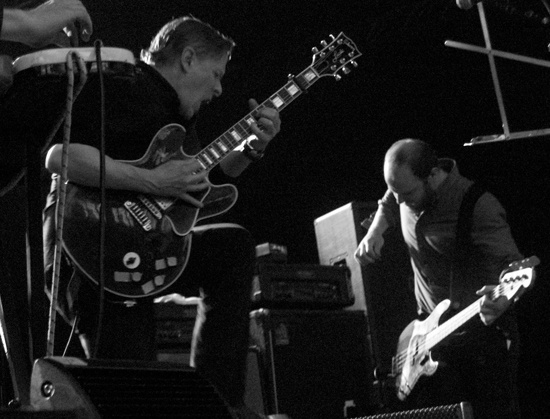
During 2010 and 2011, Swans lurched around Europe with the deafening swagger of the only rock band that mattered. Gira spat booze, thrusted and lurched his body around and shouted his way through every show, in front of original guitarist Norman Westberg, the indomitable percussionist Thor Harris (who Gira describes as “a stellar human” and performed with Angels of Light and Devendra Banhart, who Gira first put out on Young God), guitarist Christoph Hahn, drummer Phil Puleo and Chris Pravdica. At Primavera 2011, after a pounding outdoor set that brutalised and beatified the Parc del Forum in Barcelona, Gira screamed instructions to the Spanish people: “Overthrow your government now!”
The band stands out starkly on today’s circuit because each band member really does give it everything. “Unfortunately, I am cast in the role of taskmaster,” says Gira, with a nod to his reputation as the band’s unforgiving general, barking orders. “It creates some tension as I am constantly screaming at them, to push it harder. I developed this mildly sadistic technique of having the venue turn off the air conditioning when we play, so it is extremely hot. For us as performers, it makes things doubly difficult, but it works and that’s all that matters. This is my life and it is all that is gonna be left behind besides my wonderful children, so I don’t see any reason to do it half way.”
To Gira’s delight, Swans’ audience has evolved to represent the wider demographic that extreme guitar music serves today. “In the eighties, rock music gigs were mostly attended by males and it’s been heartening to see at least a fair amount of young ladies in the audience — not particularly for any salacious motives, but it’s just good to see that it’s no longer viewed as a testosterone event. It’s not just dudes in black t-shirts.”
And the amount of younger people attending Swans gigs pleases Gira. “If there were a plethora of people my age, I would definitely find that to be a motivation for suicide,” he says with a chuckle. “I think the internet certainly has enabled the music to reach more people who are likely to enjoy the experience. The tendrils reach out to different social groups. Whereas before, people were limited to music magazines — and who reads those fucking things!”


